KhetiVidyaहिंदी
All crops

Vegetable · Solanaceae (nightshade family)

Potato

Aloo · आलू · Solanum tuberosum

The king of winter vegetables — it grows under the ridge and is sold by the quintal.

Potato is the biggest winter vegetable of North India. Uttar Pradesh grows more potato than any other state, and the Doaba belt of Punjab is the country's main source of healthy seed potato. It is planted on ridges in October, fills its tubers in the cool, short days of December–January and is dug from January to March.

Sowing
1 Oct – 10 Nov
Harvest
15 Jan – 15 Mar
Duration
80–120 days
Yield
101–142 q/acre
250–350 q/ha
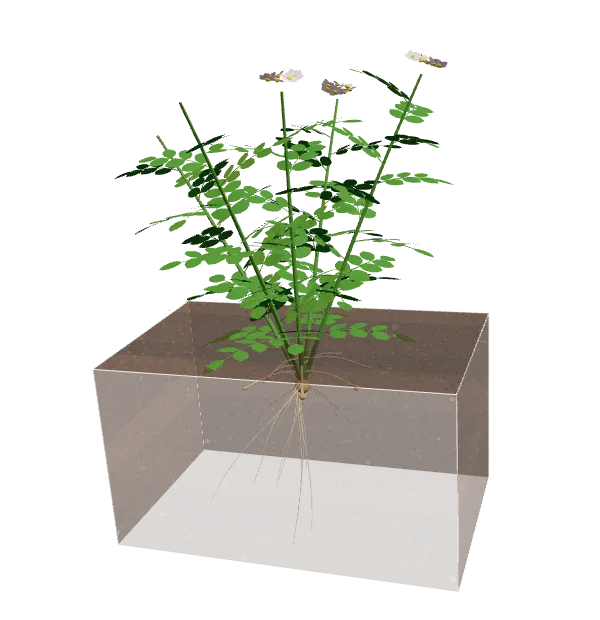
Potato plant with its roots, in a glass tank

Tuber initiation and flowering · roots shown through the soil

At a glance

Potato in one look

Tubers form best when nights are 15–20 °C. Above about 30 °C tuber formation stops, and frost (below 0 °C) can blacken the whole crop in one night.

Sowing time

1 Oct – 10 Nov

Harvest

15 Jan – 15 Mar

80–120 days from sowing

Temperature

15–25 °C to grow

18–25 °C at sowing

Soil

Well-drained sandy loam to loam, loose and rich in organic matter

pH 5.5–7.5

Seed rate

1012–1214 kg/acre

2500–3000 kg/ha

Spacing

60 × 20 cm

5–7 cm deep

Irrigations

7–10

4 critical stages

Yield

101–142 q/acre

250–350 q/ha

Season

AugSepOctNovDecJanFebMarAprMayJun
Grown most inUttar PradeshBiharPunjabHaryanaMadhya Pradesh

Loose soil lets tubers swell into a good shape. Avoid waterlogged, saline or alkaline fields — tubers rot or stay small.

Seed to harvest

Watch potato grow, stage by stage

Scroll through the season. The plant in the glass tank grows to each stage — roots and all — and every card says what the crop is doing and what you should do in the field that week.

Potato plant with its roots, in a glass tank

Stage 1 of 7

Seed tuber planted

Day 0–7

  1. 1Day 0–7

    Seed tuber planted

    The sprouted seed tuber sits in the moist ridge. Its sprouts start to push upward and roots form at their base, using food stored in the tuber.

    Your job · Plant on time in moist soil with sprouts facing up. Spray pre-emergence weedicide within 2–3 days.

  2. 2Day 8–20

    Emergence

    Shoots break through the ridge and the first leaves open. Roots spread into the loose soil.

    Your job · Give the first light irrigation. Check for missing hills and replant them early.

  3. 3Day 21–30

    Early leafy growth

    The plant forms a small bush of compound leaves and underground stems (stolons) start to grow.

    Your job · Top-dress the second half of nitrogen and earth up the ridges at 25–30 days.

  4. 4Day 31–45

    Stolon formation

    Stolons spread sideways inside the ridge. The canopy grows fast and starts to cover the furrows.

    Your job · Irrigate every 8–10 days, keep ridges intact and start watching for late blight in foggy weather.

  5. 5Day 46–60

    Tuber initiation and flowering

    The tips of the stolons swell into tiny tubers. Some varieties flower now — flowering is a sign tubers have started.

    Your job · Never let the soil dry. Spray mancozeb as a preventive when fog sets in.

  6. 6Day 61–90

    Tuber bulking

    Tubers grow rapidly — most of the yield is added in these weeks.

    Your job · Light irrigation every 7–10 days, protect from frost, and cover any exposed tubers with soil.

  7. 7Day 91–120

    Maturity and haulm cutting

    Leaves turn yellow and dry, and the tuber skin hardens so it no longer peels when rubbed.

    Your job · Stop irrigation 10–15 days before. Cut the haulms, leave tubers in the soil 10–15 days to set the skin, then dig.

The seed

Good seed is half the harvest

Use certified seed of a variety bred for your region, at the right rate, and treat it before sowing.

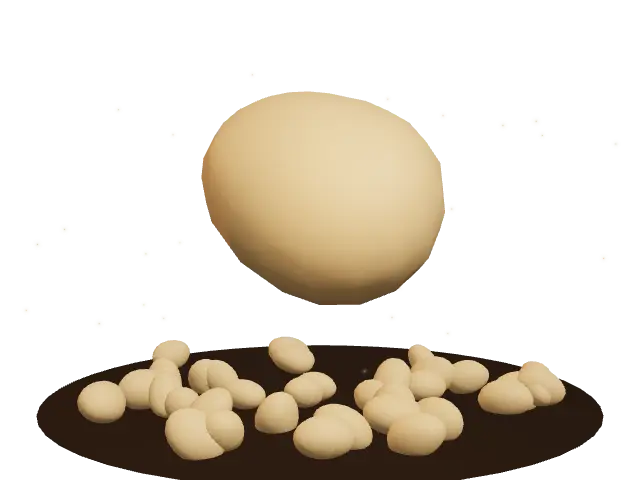
Potato seeds, close up

One seed tuber

≈ 45 mm

Seed rate

1012–1214 kg/acre

2500–3000 kg/ha

1000-seed weight

—

Recommended varieties

Kufri PukhrajEarly (70–90 days), very high yielding; the most popular early variety of the plains.
Kufri BaharMedium (90–110 days), white oval tubers; widely grown for table use in UP.
Kufri JyotiMedium maturity, white tubers, some tolerance to late blight.
Kufri BadshahLarge tubers, moderately resistant to late and early blight.
Kufri Chipsona-1Processing variety — high dry matter, low sugar, good for chips.
Kufri SindhuriLate, red-skinned tubers; hardy and stores well.

Seed treatment

  1. 1Use certified, disease-free seed tubers of 40–50 g. Replace seed with fresh certified seed every 3–4 years.
  2. 2Bring seed out of cold store 10–15 days before planting and keep in diffused light so short, green, sturdy sprouts form.
  3. 3If you cut big tubers, keep 2–3 eyes and 25–40 g per piece, and let the cut surface dry (cure) for a day or two in shade before planting.
  4. 4Dip seed tubers in 3% boric acid for 20–30 minutes against black scurf and common scab; dry in shade before planting.

Field & sowing

Prepare the land, then sow at the right gap and depth

Planting seed tubers on ridges, by hand or with a potato planter

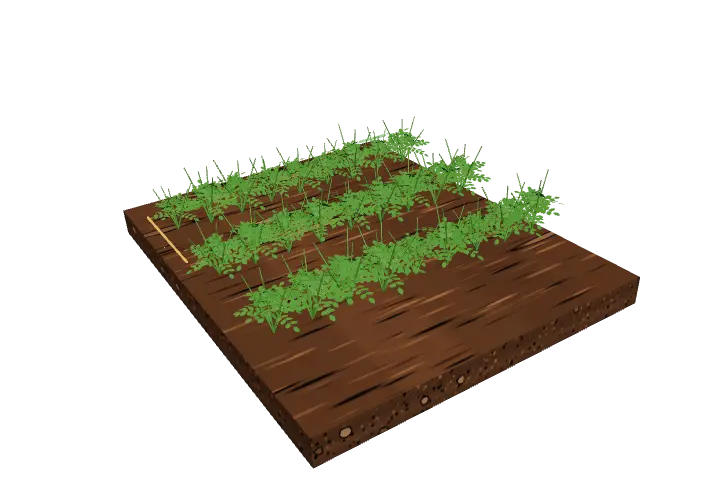
A Potato field, showing rows and spacing

Layout

Ridges & furrows

Row to row

60 cm

Plant to plant

20 cm

Depth

5–7 cm

Land preparation

  1. 1Plough deep once, then harrow 2–3 times until the soil is fine and loose.
  2. 2Mix 20–25 tonnes of well-rotted farmyard manure per hectare at the last ploughing.
  3. 3Level the field with a plank so water spreads evenly in the furrows.
  4. 4If the soil is dry, give a pre-sowing irrigation (rauni) and plant at the right moisture.

Sowing, step by step

  1. 1Open furrows 60 cm apart (60–67.5 cm with a planter).
  2. 2Put fertiliser in the furrow and mix it lightly with soil so it does not touch the seed.
  3. 3Place seed tubers 20 cm apart with sprouts facing up.
  4. 4Cover them with soil to make ridges, so the seed sits 5–7 cm below the ridge top.
  5. 5Give the first light irrigation within a week, without letting water climb over the ridges.

Feeding the crop

How much fertiliser, and when

These are the standard doses for a medium-fertility field. Your Soil Health Card can raise or lower them — test first, then feed.

Nutrient dose

Nitrogen (N)73 kg/acre · 180 kg/ha
Phosphorus (P₂O₅)32 kg/acre · 80 kg/ha
Potassium (K₂O)40 kg/acre · 100 kg/ha

Plus 20 t/ha (8.1 t/acre) of well-rotted farmyard manure or compost.

When to apply

  1. 1At planting: half the nitrogen and all the phosphorus and potash, placed in the furrows.
  2. 2At earthing up (25–30 days after planting): the remaining half of the nitrogen, then cover with soil.
  3. 3Do not give nitrogen late — it keeps the haulms green and delays skin setting.

Micronutrients, sulphur & biofertilisers

  1. 1Zinc sulphate 25 kg/ha where the soil test shows zinc is low.
  2. 2Use single super phosphate or gypsum as the phosphorus source to supply sulphur as well.

Bags for your field

For 1 acre of Potato

What to buy

Urea

3

bags · 131 kg

DAP

1.5

bags · 70 kg

MOP

1.5

bags · 67 kg

Nutrients in it: N 73 kg · P₂O₅ 32 kg · K₂O 40 kg

Also add farmyard manure or compost: 8.1 t

  • Don't put it all in at once: follow the timing on the Potato page.
  • Your Soil Health Card can raise or lower these amounts. If you have one, follow it.
  • Using SSP, NPK complexes or gypsum instead changes these amounts; the nutrient dose is what matters.

Not yet checked against a package of practices. Confirm the dose with your KVK before you buy.

Urea has 46 % N; DAP 18 % N and 46 % P₂O₅; MOP 60 % K₂O. Urea comes in 45 kg bags, DAP and MOP in 50 kg.

Water

7–10 irrigations — never miss the critical ones

A crop forgives a late irrigation at some stages and punishes it at others. These are the days that decide yield.

Day 10
Day 30
Day 45
Day 70
SowingDay 120

Critical irrigations

  1. Day 10Sprout emergence
  2. Day 30Stolon formation
  3. Day 45Tuber initiation
  4. Day 70Tuber bulking

Watering tips

  1. 1Give light irrigations every 7–12 days; water should reach only two-thirds up the ridge.
  2. 2Never let the soil dry out at tuber initiation and bulking — tubers crack or stay small.
  3. 3Irrigate lightly in the evening when frost is forecast; wet soil keeps the field warmer.
  4. 4Stop irrigation 10–15 days before cutting the haulms.

Protection

Weeds, pests and diseases to watch for

Walk the field every week. Most problems are cheap to stop early and expensive to fix late. For any spray, follow the label dose and check with your KVK.

Disease

Late blight

Signs · Water-soaked dark brown patches on leaves with white mould underneath, in cool, foggy, humid weather (December–January). A whole field can collapse within days; tubers get a reddish-brown rot.

Manage · Plant healthy seed and tolerant varieties such as Kufri Badshah. When foggy weather sets in, spray mancozeb 0.2% (2 g per litre) as a preventive. Once spots appear, spray cymoxanil + mancozeb or dimethomorph + mancozeb and repeat every 7–10 days — as per label / your KVK.

Disease

Early blight

Signs · Dark brown spots with rings like a target board, first on older lower leaves.

Manage · Give balanced fertiliser — weak, hungry plants get it first. Remove infected crop debris and rotate crops. Spray mancozeb when spots appear — as per label / your KVK.

Pest

Aphids and viruses

Signs · Small green insects under the leaves suck sap and spread viruses. Infected plants show mosaic, curled or rolled leaves and give small tubers — a big problem for seed crops.

Manage · Plant early so tubers form before aphids build up. Pull out virus-looking plants early. For a seed crop, cut haulms when aphids cross about 20 per 100 leaves (seed plot technique). If needed, spray imidacloprid — as per label / your KVK.

Pest

Cutworm

Signs · Young stems cut at soil level overnight; grey caterpillars curled up in the soil near damaged plants.

Manage · Plough deep in summer to expose pupae. Hand-pick caterpillars in the evening. Irrigate the field. Use soil treatment only on advice — as per label / your KVK.

Disorder

Frost

Signs · After a clear, still, very cold night in late December–January, leaves turn black and wilt by morning.

Manage · Give a light irrigation when frost is forecast and make smoke on the windward side of the field at night.

Disorder

Greening of tubers

Signs · Tubers pushed out of the ridge turn green in sunlight. Green parts are bitter and harmful to eat (solanine).

Manage · Earth up properly and keep tubers covered with soil. Store tubers in the dark.

Disease

Black scurf and common scab

Signs · Black, dirt-like specks that do not wash off (black scurf) or rough, corky spots (scab) on the tuber skin.

Manage · Use clean seed, dip seed in 3% boric acid before planting, rotate potato with cereals and keep the soil moist at tuber initiation.

Weeds

Common · Bathua, krishan neel, gajar ghas (parthenium), doob grass and motha

  1. 1Earthing up at 25–30 days buries most weeds.
  2. 2Pre-emergence spray of metribuzin or pendimethalin within 2–3 days of planting, before sprouts come up — as per label / your KVK.
  3. 3Pull out late weeds by hand so they do not shade the ridges.

Harvest

Harvest on time, dry it well, store it safe

A good crop gives

101–142q/acre

250–350 quintal per hectare

Early-dug crops yield less but often fetch a better price.

When is it ready?

  1. 1Leaves and stems turn yellow and start drying.
  2. 2The skin does not peel off when rubbed hard with the thumb.
  3. 3Tubers come off the stolons easily.

Harvesting

  1. 1Cut the haulms at ground level 10–15 days before digging.
  2. 2Dig with a potato digger or kassi when the soil is slightly moist.
  3. 3Avoid cuts and bruises, and finish digging before days get hot (above about 30 °C).

After harvest & storage

  1. 1Heap tubers in shade for 10–15 days, covered with straw, to cure and heal small wounds.
  2. 2Sort out cut, rotten and green tubers, then grade by size.
  3. 3Seed potatoes: cold store at 2–4 °C.
  4. 4Table and processing potatoes: store at about 8–12 °C with a sprout suppressant so they do not turn sweet.

Golden rules for potato

  1. 1Use certified seed and renew it every 3–4 years — most potato diseases come in with the seed.
  2. 2Let cut seed pieces dry before planting; never plant freshly cut seed in warm, wet soil.
  3. 3Earth up on time so tubers stay covered and do not turn green.
  4. 4Spray against late blight before it appears when foggy weather sets in — after it spreads, it is very hard to stop.
  5. 5Stop irrigation before harvest and cure tubers well; they keep much longer.