Pest
Thrips
Signs · Silvery-white streaks on leaves, leaf tips twist and dry; worse in warm, dry spells of February–March.
Manage · Barrier rows of maize or wheat and blue sticky traps. Spray only if numbers are high — as per label / your KVK.
Vegetable · Amaryllidaceae (onion family)
Lahsun · लहसुन · Allium sativum
Plant a clove in autumn, dig up a whole bulb in spring.
Garlic is a high-value spice-cum-vegetable grown from cloves, not seed. It is planted in late September–October, grows its leaves through the cool winter and forms its cloves when the days lengthen in spring. A well-cured crop stores for months, so farmers can wait for a good price.
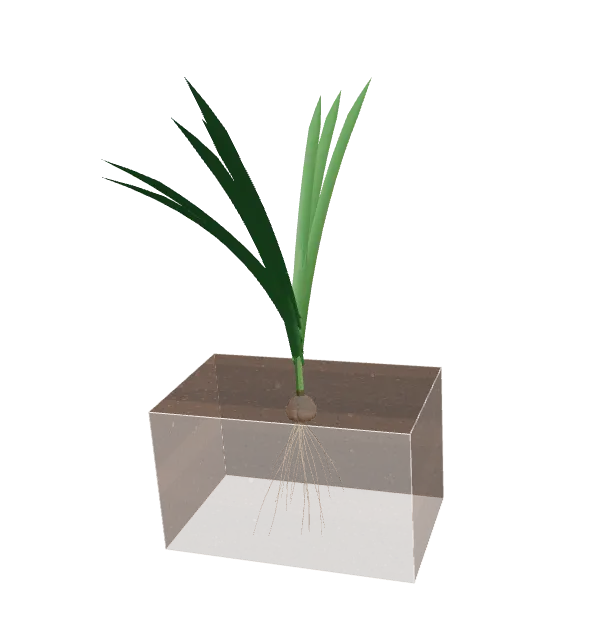
Bulb development · roots shown through the soil
At a glance
Garlic needs cool, moist weather for leaf growth and a spell of cold to form cloves. Longer, warmer days in spring then make the bulb swell. Late planting gives small bulbs.
Sowing time
25 Sep – 31 Oct
Harvest
25 Mar – 30 Apr
150–180 days from sowing
Temperature
12–24 °C to grow
18–25 °C at sowing
Soil
Well-drained loam rich in organic matter
pH 6–7.5
Seed rate
202–283 kg/acre
500–700 kg/ha
Spacing
15 × 7.5 cm
4–5 cm deep
Irrigations
10–12
3 critical stages
Yield
40–61 q/acre
100–150 q/ha
Season
Heavy clay soils give misshapen bulbs that are hard to dig. Avoid waterlogging — it rots the bulbs.
Seed to harvest
Scroll through the season. The plant in the glass tank grows to each stage — roots and all — and every card says what the crop is doing and what you should do in the field that week.
Stage 1 of 7
Clove planting
Day 0–7
The clove takes up moisture and roots start from its flat base.
Your job · Plant upright with the pointed end up, 4–5 cm deep, and irrigate lightly.
A green shoot pushes up through the soil.
Your job · Keep the soil moist and fill gaps early with spare cloves.
The plant opens 3–5 flat, strap-shaped leaves.
Your job · First weeding and the first nitrogen top-dressing at 30 days.
The plant builds 8–12 leaves and stores food for the bulb.
Your job · Second nitrogen split at 45 days, weeding, irrigation every 10–15 days and thrips scouting.
As days lengthen, cloves start forming inside the swollen leaf bases.
Your job · Keep the soil evenly moist and give no more nitrogen.
Cloves fill out and the bulb swells and firms.
Your job · Irrigate regularly and watch for purple blotch.
Leaves turn yellow-brown from the tips and the neck softens and bends.
Your job · Stop irrigation 10–15 days before and dig when most leaves have dried.
The seed
Use certified seed of a variety bred for your region, at the right rate, and treat it before sowing.
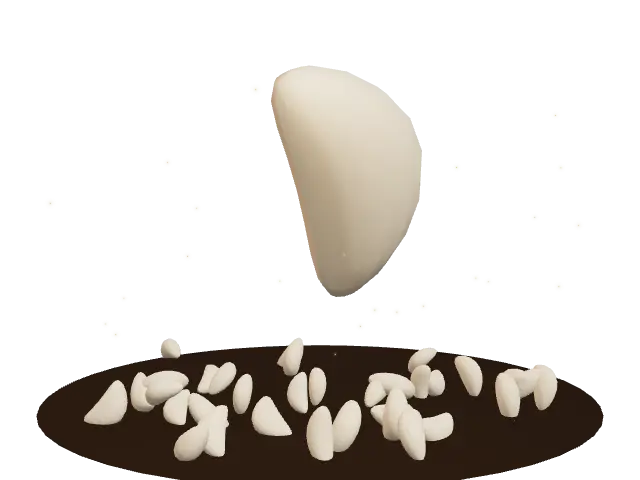
One clove
≈ 20 mm
Seed rate
202–283 kg/acre
500–700 kg/ha
1000-seed weight
—
Field & sowing
Dibbling single cloves on flat beds
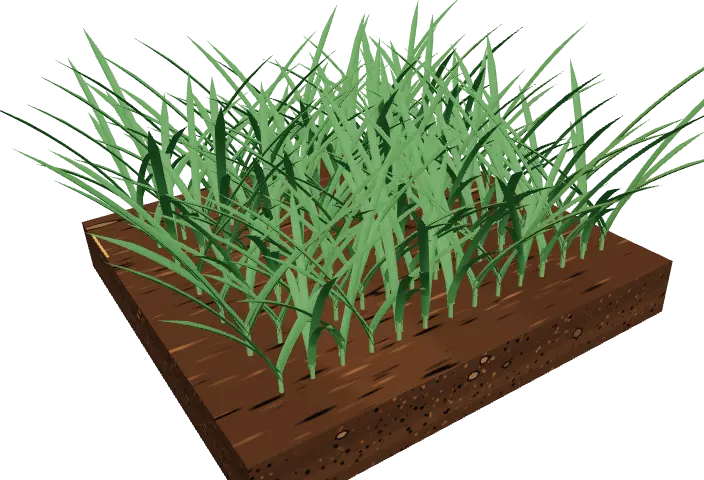
Layout
Flat beds
Row to row
15 cm
Plant to plant
7.5 cm
Depth
4–5 cm
Feeding the crop
These are the standard doses for a medium-fertility field. Your Soil Health Card can raise or lower them — test first, then feed.
Nutrient dose
Plus 20 t/ha (8.1 t/acre) of well-rotted farmyard manure or compost.
For 1 acre of Garlic
What to buy
Urea
1.5
bags · 71 kg
DAP
1
bag · 44 kg
MOP
0.5
bags · 34 kg
Nutrients in it: N 40 kg · P₂O₅ 20 kg · K₂O 20 kg
Also add farmyard manure or compost: 8.1 t
Not yet checked against a package of practices. Confirm the dose with your KVK before you buy.
Urea has 46 % N; DAP 18 % N and 46 % P₂O₅; MOP 60 % K₂O. Urea comes in 45 kg bags, DAP and MOP in 50 kg.
Water
A crop forgives a late irrigation at some stages and punishes it at others. These are the days that decide yield.
Protection
Walk the field every week. Most problems are cheap to stop early and expensive to fix late. For any spray, follow the label dose and check with your KVK.
Signs · Silvery-white streaks on leaves, leaf tips twist and dry; worse in warm, dry spells of February–March.
Manage · Barrier rows of maize or wheat and blue sticky traps. Spray only if numbers are high — as per label / your KVK.
Signs · Purple spots with yellow borders or yellow-brown streaks on leaves; leaves dry from the tip.
Manage · Rotate crops, remove debris and spray mancozeb with a sticker when spots appear — as per label / your KVK.
Signs · Leaves yellow from the tip, roots rot, and white fungus grows on the base of the bulb.
Manage · Plant healthy cloves, avoid waterlogging, apply Trichoderma with FYM and keep garlic and onion off that field for 3–4 years.
Signs · Cloves sprout into extra shoots in the field and bulbs split open.
Manage · Avoid excess and late nitrogen, and keep irrigation regular.
Signs · Bulbs stay small or form one round clove instead of many.
Manage · Plant on time and use large outer cloves; late planting and small cloves are the usual causes.
Common · Bathua, motha, doob grass and other winter weeds
Harvest
A good crop gives
40–61q/acre
100–150 quintal per hectare