Disease
Stem gall
Signs · Swellings (galls) on stems, leaf stalks and flower stalks; seeds become deformed.
Manage · Grow resistant RCr 41, use clean treated seed, rotate crops. Fungicide spray on KVK advice, as per label.
Spice · Apiaceae (carrot family)
Dhaniya · धनिया · Coriandrum sativum
Green leaves in a month, fragrant seed spice by spring.
Coriander is grown for its seed (a major seed spice of Rajasthan's Kota–Baran–Jhalawar belt and MP) and for green leaves across North India. The crop is cool-season, fairly low in water need, and pays well when the seed keeps its green colour and aroma.
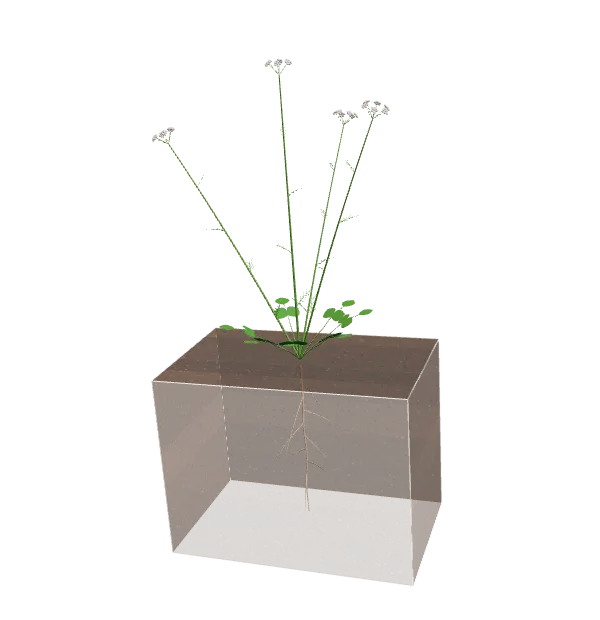
Flowering · roots shown through the soil
At a glance
Cool, dry weather suits it. Frost at flowering damages umbels; cloudy, humid weather brings powdery mildew and aphids.
Sowing time
15 Oct – 15 Nov
Harvest
1 Mar – 10 Apr
110–140 days from sowing
Temperature
10–25 °C to grow
18–25 °C at sowing
Soil
Well-drained loam to clay loam; black soils of the Kota region
pH 6.5–8
Seed rate
4.9–6.1 kg/acre
12–15 kg/ha
Spacing
30 × 10 cm
2–3 cm deep
Irrigations
4–6
4 critical stages
Yield
4.9–7.3 q/acre
12–18 q/ha
Season
Waterlogging invites wilt. Good organic matter improves yield.
Seed to harvest
Scroll through the season. The plant in the glass tank grows to each stage — roots and all — and every card says what the crop is doing and what you should do in the field that week.
Stage 1 of 7
Sowing
Day 0–3
Split seed absorbs water in moist soil.
Your job · Sow in lines; light irrigation on light soils; pre-emergence weedicide.
Two narrow seed leaves emerge — coriander is slow, taking 10–15 days.
Your job · Be patient; keep the top soil moist with a light irrigation if it crusts.
Broad, lobed true leaves form a small rosette.
Your job · Thin to 10 cm and weed at 30 days. Leaf crop can be cut now.
Stems grow up and branch; upper leaves become finely divided.
Your job · Top-dress nitrogen with irrigation; second weeding.
Small white-pink flowers open in umbrella-shaped clusters (umbels).
Your job · Irrigate; watch for aphids, powdery mildew and frost.
Round green fruits form and fill.
Your job · Last irrigations; keep scouting for powdery mildew.
Fruits turn from green to brownish-yellow.
Your job · Harvest when about half the fruits turn brownish-yellow — don't wait for full brown.
The seed
Use certified seed of a variety bred for your region, at the right rate, and treat it before sowing.
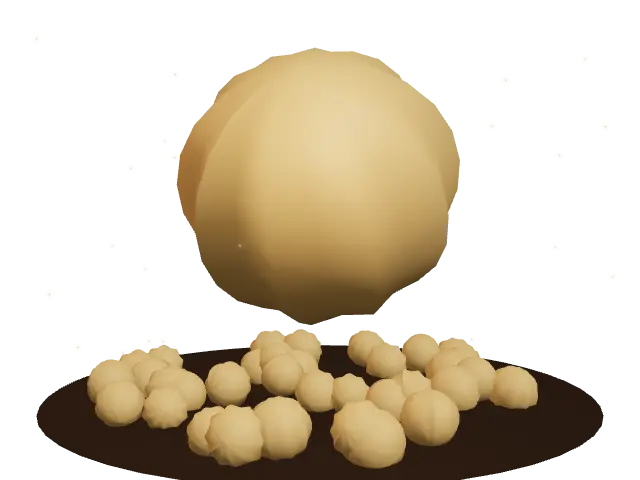
One seed
≈ 4 mm
Seed rate
4.9–6.1 kg/acre
12–15 kg/ha
1000-seed weight
—
Field & sowing
Line sowing in small beds
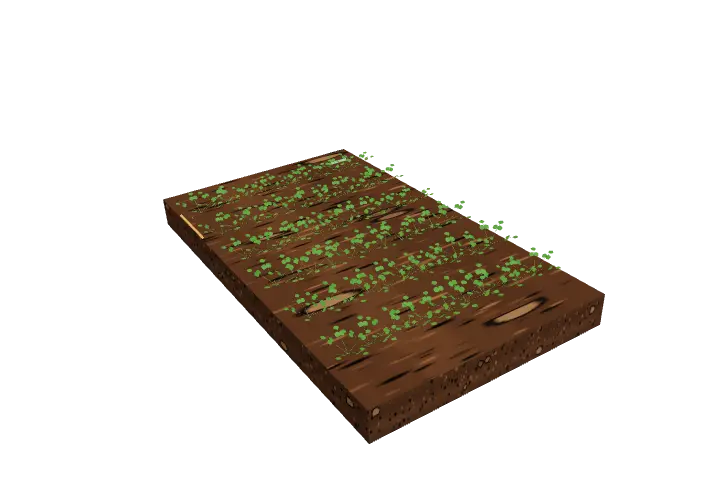
Layout
Flat beds
Row to row
30 cm
Plant to plant
10 cm
Depth
2–3 cm
Feeding the crop
These are the standard doses for a medium-fertility field. Your Soil Health Card can raise or lower them — test first, then feed.
Nutrient dose
Plus 10 t/ha (4 t/acre) of well-rotted farmyard manure or compost.
For 1 acre of Coriander
What to buy
Urea
1
bag · 39 kg
DAP
0.5
bags · 35 kg
MOP
0.5
bags · 13 kg
Nutrients in it: N 24 kg · P₂O₅ 16 kg · K₂O 8.1 kg
Also add farmyard manure or compost: 4 t
Not yet checked against a package of practices. Confirm the dose with your KVK before you buy.
Urea has 46 % N; DAP 18 % N and 46 % P₂O₅; MOP 60 % K₂O. Urea comes in 45 kg bags, DAP and MOP in 50 kg.
Water
A crop forgives a late irrigation at some stages and punishes it at others. These are the days that decide yield.
Protection
Walk the field every week. Most problems are cheap to stop early and expensive to fix late. For any spray, follow the label dose and check with your KVK.
Signs · Swellings (galls) on stems, leaf stalks and flower stalks; seeds become deformed.
Manage · Grow resistant RCr 41, use clean treated seed, rotate crops. Fungicide spray on KVK advice, as per label.
Signs · White powder on leaves and umbels in late winter; seeds stay small.
Manage · Spray wettable sulphur at first appearance, as per label / your KVK.
Signs · Plants droop, turn yellow and dry; roots look brown inside.
Manage · Seed treatment, crop rotation, avoid waterlogging and very early sowing in warm soil.
Signs · Small insects on tender shoots and umbels at flowering; umbels shrivel.
Manage · Encourage ladybird beetles; spray neem oil or an insecticide as per label / your KVK, in the afternoon to spare bees.
Signs · Flowers and young seeds turn dark and drop after a frosty night.
Manage · Light irrigation and smoke on frosty nights.
Common · Bathua, krishneel, motha and grasses — coriander grows slowly at first and is easily smothered
Harvest
A good crop gives
4.9–7.3q/acre
12–18 quintal per hectare
Seed yield. A leaf crop can be cut from 30–40 days onward.