Pest
Aphids
Signs · Small green insects on young leaves in January–February; leaves curl and yellow.
Manage · Spray neem oil at the first colonies; use imidacloprid only if they spread — as per label / your KVK, respecting the waiting period.
Vegetable · Apiaceae (carrot family)
Gajar · गाजर · Daucus carota
Loose, stone-free soil and even watering grow straight, deep-red roots.
The deep-red Asiatic carrot is a North Indian winter favourite — eaten raw, cooked into gajar halwa and pressed into kanji. Its quality is decided underground: a root that meets a clod, a stone or fresh manure forks, and one that gets uneven water cracks.
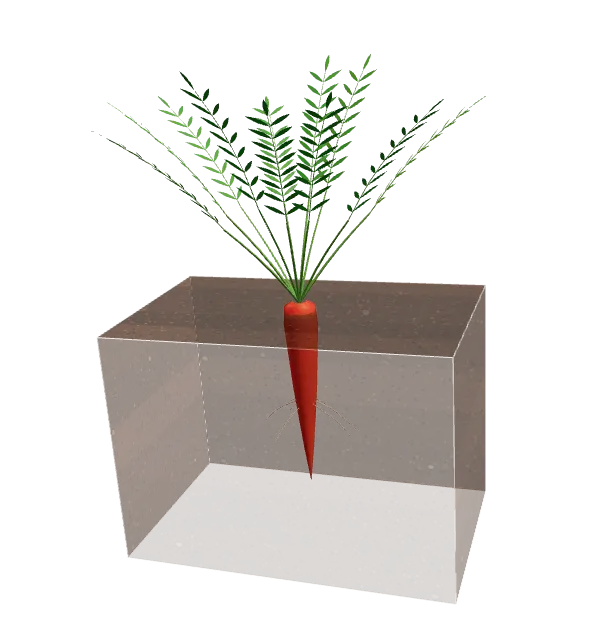
Harvest-ready · roots shown through the soil
At a glance
Asiatic red carrots handle the warm days of September sowing. Deep red colour develops best between 15 and 20 °C.
Sowing time
1 Sep – 31 Oct
Harvest
25 Nov – 28 Feb
85–110 days from sowing
Temperature
15–20 °C to grow
18–28 °C at sowing
Soil
Deep, loose sandy loam or loam
pH 6–7.5
Seed rate
2.4–4 kg/acre
6–10 kg/ha
Spacing
45 × 8 cm
1–1.5 cm deep
Irrigations
6–9
3 critical stages
Yield
81–121 q/acre
200–300 q/ha
Season
Stones, clods, a hard pan or fresh manure make roots fork and grow hairy. Soil must be loose to at least 30 cm.
Seed to harvest
Scroll through the season. The plant in the glass tank grows to each stage — roots and all — and every card says what the crop is doing and what you should do in the field that week.
Stage 1 of 7
Sowing
Day 0–7
Soaked seed is sown shallow on moist ridges.
Your job · Keep the ridge top moist with light irrigations.
Thin, grass-like seed leaves appear — slowly, over 1–2 weeks.
Your job · Do not let the surface crust or dry out.
Fern-like true leaves open and a thin taproot dives down.
Your job · Weed by hand and thin plants to 7–8 cm.
The leafy top fills out while the root lengthens.
Your job · Top-dress nitrogen, earth up and irrigate.
The root starts to widen and colour from the shoulder down.
Your job · Keep moisture steady; keep shoulders covered.
Roots fill out and turn deep red as nights get cold.
Your job · Even irrigations; watch for aphids and leaf blight.
Roots reach full length and colour.
Your job · Dig on time — late roots turn woody and crack.
The seed
Use certified seed of a variety bred for your region, at the right rate, and treat it before sowing.
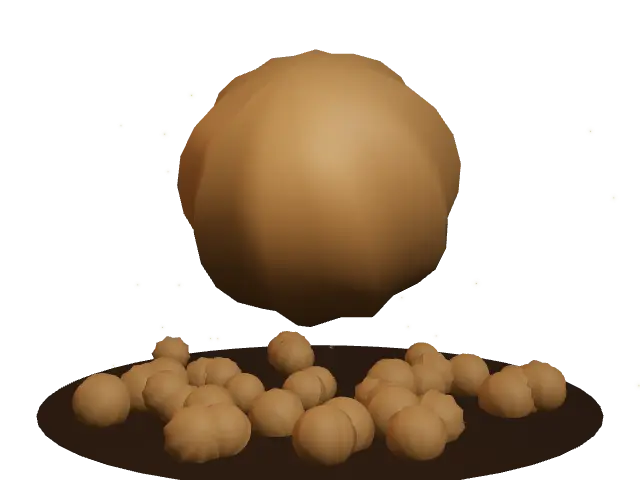
One seed
≈ 3 mm
Seed rate
2.4–4 kg/acre
6–10 kg/ha
1000-seed weight
—
Field & sowing
Line sowing on ridges
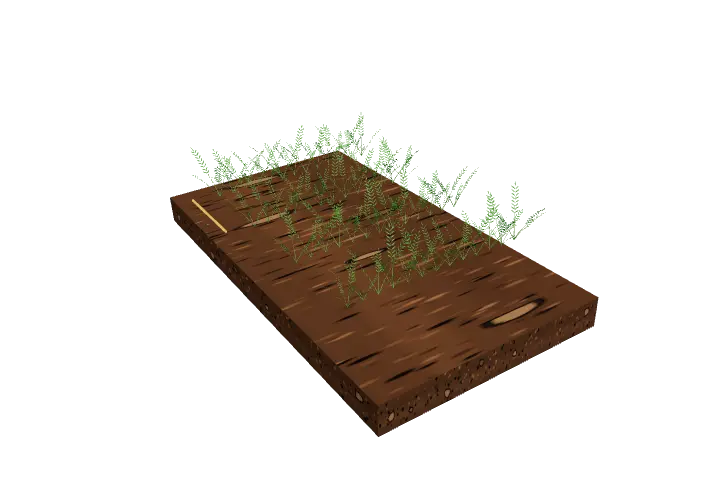
Layout
Ridges & furrows
Row to row
45 cm
Plant to plant
8 cm
Depth
1–1.5 cm
Feeding the crop
These are the standard doses for a medium-fertility field. Your Soil Health Card can raise or lower them — test first, then feed.
Nutrient dose
Plus 15 t/ha (6.1 t/acre) of well-rotted farmyard manure or compost.
For 1 acre of Carrot
What to buy
Urea
1
bag · 39 kg
DAP
0.5
bags · 35 kg
MOP
0.5
bags · 34 kg
Nutrients in it: N 24 kg · P₂O₅ 16 kg · K₂O 20 kg
Also add farmyard manure or compost: 6.1 t
Not yet checked against a package of practices. Confirm the dose with your KVK before you buy.
Urea has 46 % N; DAP 18 % N and 46 % P₂O₅; MOP 60 % K₂O. Urea comes in 45 kg bags, DAP and MOP in 50 kg.
Water
A crop forgives a late irrigation at some stages and punishes it at others. These are the days that decide yield.
Protection
Walk the field every week. Most problems are cheap to stop early and expensive to fix late. For any spray, follow the label dose and check with your KVK.
Signs · Small green insects on young leaves in January–February; leaves curl and yellow.
Manage · Spray neem oil at the first colonies; use imidacloprid only if they spread — as per label / your KVK, respecting the waiting period.
Signs · Small knots (galls) on roots, hairy or forked carrots, stunted plants.
Manage · Deep summer ploughing, rotation with wheat or marigold, and neem cake in the soil. Do not grow carrot in the same field year after year.
Signs · Dark brown spots on leaf edges that join up; leaves dry from the tips.
Manage · Clean seed and rotation. Spray mancozeb at 2.5 g per litre at first spots — as per label / your KVK.
Signs · White powdery coating on leaves, mostly in February–March.
Manage · Avoid late sowing; spray wettable sulphur if it spreads — as per label / your KVK.
Signs · Roots split into two or more legs.
Manage · Loose, stone-free soil, no fresh manure, control nematodes and thin plants on time.
Signs · Long splits along the root.
Manage · Irrigate evenly, harvest on time and correct boron shortage.
Signs · The top of the root turns green where it pokes out of the soil.
Manage · Earth up the ridges so the shoulders stay covered.
Common · Bathua (Chenopodium), krishneel (Anagallis), gajri (Fumaria), motha (Cyperus)
Harvest
A good crop gives
81–121q/acre
200–300 quintal per hectare